#21: Dormant Commerce and State FOIAs

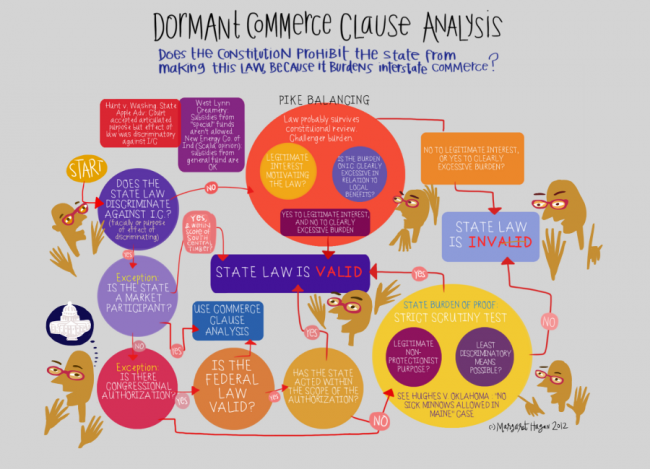
The Dormant Commerce Clause Maze

There has been a great deal of debate about whether the Founders intended that the Commerce Clause be read to include a restriction on the right of states to engage in certain regulation of commerce. This interpretation of the Commerce Clause is called the “dormant” or “negative” Commerce Clause. The application of the Dormant Commerce Clause was one of the main questions in a recent case, McBurney v. Young (2013).

As SCOTUSblog’s Lyle Dennison explains,

Under the Commerce Clause, Congress has broad authority to pass laws regulating trade and commerce among the states, but the courts have found “dormant” within that Clause a ban on states’ discrimination against interstate commercial activity by treating its own residents more favorably than outsiders.

At the center of the new case before the Court are state “freedom of information” (FOI) or “open records” laws.   At one time, at least ten states had FOI laws that restricted access to their agencies’ public records to citizens of their own state.  Seven of those states have since repealed those limitations.  Now, according to critics of such laws, only the states of Arkansas, Tennessee, and Virginia continue to enforce their laws.  Virginia’s law is the one at issue in McBurney v. Young, now before the Court.

“Under the Virginia Freedom of Information Act, which dates from 1968, the right to inspect and copy public records is limited to “any citizens of the Commonwealth.”   At one time, citizens seeking access had to show a “personal or legal interest” in the records, but that was taken out of the law in 1974.  Newspapers and magazines that circulate in the state and radio and TV stations located in the state or broadcasting into it from elsewhere are also assured of access.   The state law only applies, the state has argued, to non-judicial records; court records are open to all, including real estate titles, tax files, and court judgment files.   As is true of many open-records laws, the Virginia law requires those seeking access to pay fees to cover the actual cost of search and copying.” (Lyle Dennison’s Argument Preview: How Open are Public Records?”)

Listen to this wrap-up of the Court’s decision in the case. Post-Decision SCOTUScast–McBurney v. Young.

What should we make of this dormant Commerce Clause? Justice Thomas, a longtime critic of the idea, wrote a very short concurring opinion in which he argued against such a thing:

“I join the Court’s opinion. Though the Court has properly applied our dormant Commerce Clause precedents, I continue to adhere to my view that ‘[t]he negative Commerce Clause has no basis in the text of the Constitution, makes little sense, and has proved virtually unworkable in application, and, consequently, cannot serve as a basis for striking down a state statute.'”(Thomas concurring in McBurney).

Does the Commerce Clause imply a limitation on state regulation of commerce, as something separate from federal preemption? What is the state of the argument today?
#22: The Tonnage Clause

As Americans, we like to pride ourselves with being very familiar with the provisions of our Constitution. But I bet you’ve never heard of the Tonnage Clause. This provision is tucked way down at the end of Article I § 10. It reads:

“No State shall, without the Consent of Congress, lay any Duty of Tonnage, keep Troops, or Ships of War in time of Peace, enter into any Agreement or Compact with another State, or with a foreign Power, or engage in War, unless actually invaded, or in such imminent Danger as will not admit of delay.”

So what is this “duty of tonnage?” Believe it or not, the Supreme Court has dealt with the interpretation of this clause in a recent case, Polar Tankers v. City of Valdez (2009). This case, which also raised Due Process and Commerce Clause questions, represents another way in which the Founders used Article I to rein in attempts by the states to use taxation as a way to burden interstate commerce.

Although the Court did not reach the Commerce Clause question, it is clear that the operation of the Tonnage Clause is to keep states from burdening interstate commerce.

Paper Topic #22: Is the Tonnage Clause an historical artifact? Does it simply replicate the Commerce Clause, or does it add something unique to the contours of Article I’s distribution of economic power among levels of government?

Suggested Reading: Jensen, E. M. (2010). Quirky Constitutional Provisions Matter: The Tonnage Clause, Polar Tankers, and State Taxation of Commerce. Geo. Mason L. Rev.,18, 669.

#21: Dormant Commerce

The Dormant Commerce Clause Maze

There has been a great deal of debate about whether the Founders intended that the Commerce Clause be read to include a restriction on the right of states to engage in certain regulation of commerce. This interpretation of the Commerce Clause is called the “dormant” or “negative” Commerce Clause. The application of the Dormant Commerce Clause was one of the main questions in a recent case, McBurney v. Young (2013).

As SCOTUSblog’s Lyle Dennison explains,

Under the Commerce Clause, Congress has broad authority to pass laws regulating trade and commerce among the states, but the courts have found “dormant” within that Clause a ban on states’ discrimination against interstate commercial activity by treating its own residents more favorably than outsiders.

At the center of the new case before the Court are state “freedom of information” (FOI) or “open records” laws.   At one time, at least ten states had FOI laws that restricted access to their agencies’ public records to citizens of their own state.  Seven of those states have since repealed those limitations.  Now, according to critics of such laws, only the states of Arkansas, Tennessee, and Virginia continue to enforce their laws.  Virginia’s law is the one at issue in McBurney v. Young, now before the Court.

“Under the Virginia Freedom of Information Act, which dates from 1968, the right to inspect and copy public records is limited to “any citizens of the Commonwealth.”   At one time, citizens seeking access had to show a “personal or legal interest” in the records, but that was taken out of the law in 1974.  Newspapers and magazines that circulate in the state and radio and TV stations located in the state or broadcasting into it from elsewhere are also assured of access.   The state law only applies, the state has argued, to non-judicial records; court records are open to all, including real estate titles, tax files, and court judgment files.   As is true of many open-records laws, the Virginia law requires those seeking access to pay fees to cover the actual cost of search and copying.” (Lyle Dennison’s Argument Preview: How Open are Public Records?”)

Listen to this wrap-up of the Court’s decision in the case. Post-Decision SCOTUScast–McBurney v. Young.

What should we make of this dormant Commerce Clause? Justice Thomas, a longtime critic of the idea, wrote a very short concurring opinion in which he argued against such a thing:

“I join the Court’s opinion. Though the Court has properly applied our dormant Commerce Clause precedents, I continue to adhere to my view that ‘[t]he negative Commerce Clause has no basis in the text of the Constitution, makes little sense, and has proved virtually unworkable in application, and, consequently, cannot serve as a basis for striking down a state statute.'”(Thomas concurring in McBurney).

Does the Commerce Clause imply a limitation on state regulation of commerce, as something separate from federal preemption? What is the state of the argument today?

#20: Obroccolicare

Broccoli Mandate

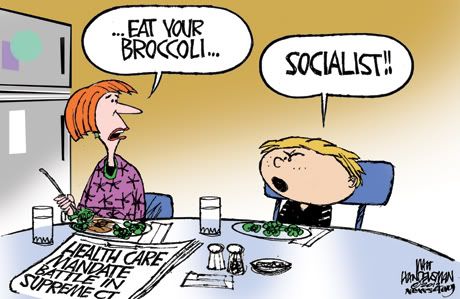
One of the more curious aspects of the Court’s decision in NFIB v. Sebelius (2012) is the fact that the opinions mention the word broccoli a dozen times. This so-called broccoli mandate captured the imagination of Obamacare’s critics in the time leading up to the Court’s decision in Sebelius. The analogy goes like this: if Congress can make you purchase health insurance, does this mean they can make you buy broccoli?”

The opinions in the case did not use the example frivolously; they really engage the problem set out by the conservative opponents to the Patient Protection and Affordable Care Act (or “Obamacare). Conservatives in the Senate laid the groundwork for the broccoli mandate in the Kagan confirmation hearings:

http://youtu.be/DSoWGlyugTo

Justice Scalia posed the broccoli question to the Solicitor General during oral arguments in the case.

“Could you define the market — everybody has to buy food sooner or later, so you define the market as food, therefore, everybody is in the market; therefore, you can make people buy broccoli.”

The broccoli mandate question is intended to help us think about the breadth of the Commerce Power. But does this work as an analogy to the government’s argument in Sebilius? What does the Court actually say about the government’s power to mandate insurance purchases under the commerce clause? Here is the majority opinion’s take:

Indeed, the Government’s logic would justify a mandatory purchase to solve almost any problem to “identify any mandate to purchase a product or service in interstate commerce that would be unconstitutional” under its theory of the commerce power. To consider a different example in the health care market, many Americans do not eat a balanced diet. That group makes up a larger percentage of the total population than those without health insurance. The failure of that group to have a healthy diet increases health care costs, to a greater extent than the failure of the uninsured to purchase insurance. Those increased costs are borne in part by other Americans who must pay more, just as the uninsured shift costs to the insured. Congress addressed the insurance problem by ordering everyone to buy insurance. Under the Government’s theory, Congress could address the diet problem by ordering everyone to buy vegetables…. According to the Government, upholding the individual mandate would not justify mandatory purchases of items such as cars or broccoli because, as the Government puts it, “[h]ealth insurance is not purchased for its own sake like a car or broccoli; it is a means of financing health-care consumption and covering universal risks.” But cars and broccoli are no more purchased for their “own sake” than health insurance. They are purchased to cover the need for transportation and food. (Chief Justice Roberts in Sebelius, excerpt courtesy of Professor Linder’s Exploring Constitutional Conflicts)

Justice Ginsberg responds in her concurrence:

As an example of the type of regulation he fears, The Chief Justice cites a Government mandate to purchase green vegetables. One could call this concern “the broccoli horrible.”…Consider the chain of inferences the Court would have to accept to conclude that a vegetable-purchase mandate was likely to have a substantial effect on the health-care costs borne by lithe Americans. The Court would have to believe that individuals forced to buy vegetables would then eat them (instead of throwing or giving them away), would prepare the vegetables in a healthy way (steamed or raw, not deep-fried), would cut back on unhealthy foods, and would not allow other factors (such as lack of exercise or little sleep) to trump the improved diet. Such “pil[ing of] inference upon inference” is just what the Court refused to do in Lopez and Morrison….When contemplated in its extreme, almost any power looks dangerous. The commerce power, hypothetically, would enable Congress to prohibit the purchase and home production of all meat, fish, and dairy goods, effectively compelling Americans to eat only vegetables. Yet no one would offer the “hypothetical and unreal possibilit[y]” of a vegetarian state as a credible reason to deny Congress the authority ever to ban the possession and sale of goods. The Chief Justice accepts just such specious logic when he cites the broccoli horrible as a reason to deny Congress the power to pass the individual mandate…. (Justice Ginsburg in Sebelius, excerpt courtesy of Professor Linder’s Exploring Constitutional Conflicts)

What do you make of the use of this broccoli analogy debate? Does the Chief have a point here? Would it be more constitutionally defensible, as some have argued, if the government had mandated broccoli purchases? What impact does the Court’s decision in Sebelius have on the power of Congress to enact laws dealing with behaviors that impact citizen health (and, therefore, the cost of healthcare)?

A few additional thoughts:

  1. Did you know that there is a whole food freedom movement dedicated to protecting your right to eat whatever the heck you want?
  2. Certainly, a broccoli mandate never would have been signed into law by President H.W. Bush.

#19: Commerce and Race

Our readings in this part of the course deal primarily with the changing interpretation of the Commerce Clause over time. To read these sections of the book, it would be easy to forget that the Court’s decisions on these cases took place in the context of an evolving economic, social, and political environment. An interesting illustration of this phenomenon is the Court’s decisions in Heart of Atlanta Motel v. US, 379 US 241 (1964) and Katenbach v. McClung, 379 US 297 (1964). In these cases, the Court extended the reach of the Commerce Clause to include the power to demand the desegregation of private businesses. While the legal question at issue was the extent of Congress’s power under the Commerce Clause, the actual substance of that decision was about race relations in America. Essentially, the Court marshalled the power of the Commerce Clause to reach where the 14th Amendment could not–private businesses.

Read this short piece by Jack Balkin. Consider the position of the Commerce Clause litigation in the context of the nation’s (slowly) evolving race relations.

Paper Topic #19: Over time, has the Court approached Commerce Clause cases differently when they directly implicate matters of race relations?

Suggested Reading: Spaeth, H. J. (1965). Race Relations and the Warren CourtU. Det. LJ43, 255.

#18: Regime Politics

Today’s readings talk about the so-called “switch in time” that happened in 1937. It’s clear that the Court’s interpretation of the Commerce Clause–which was in stark contrast to the more expansive interpretation demanded by a variety of New Deal Programs–was a thorn in FDR’s side. His so-called “court packing plan” was framed as a solution to the high workload pressures facing the Court, but nobody ever believed this was FDR’s real purpose.

The public and members of Congress, who roundly supported FDRs other New Deal policies, reacted quite negatively to the proposal. But this isn’t why the plan was never implemented. As your textbook notes, the worst of the battle “was averted in large measure by the actions of the justices themselves” (Epstein and Walker 2014, 429).

The classic version of this story posits that Justices Roberts and Hughes changed their position on the constitutionality of many New Deal programs in direct reaction to the president’s threat to pack the Court. But why would justices–with their life tenure, guaranteed salary, and seeming independence from the political branches–bend to such pressure?

The classic version of the tale argues that it probably has something to do with protecting the legitimacy of the Court. Roosevelt’s court-packing plan was a transparent attempt to bully the Court into submission; it was clearly a shot at the Court’s independence from the political branches. Were the Court to suffer this humiliation, the ability of the Court to oppose the policy preferences of the dominant national governing coalition would be forever sabotaged.

Paper Topic #18: What explains the seeming “switch in time?” Was this just a continuation of an evolution of policy positions on the part of two of the justices that might have happened regardless of FDR’s court packing plan? Or was the switch a direct result of this pressure? In any event, did the switch make a difference in the public’s esteem of the Court (or of FDR, himself)?

Suggested Reading: Caldeira, G. A. (1987). “Public Opinion and the US Supreme Court: FDR’s Court-Packing Plan.” American Political Science Review81(4), 1139-1153.

#17: The Meaning of Commerce

Our Commerce Power readings trace the development of the Commerce Power over several important spans of time: 1) before the New Deal, 2) the New Deal era, 3) the Commerce Power heyday, and 4) the modern era where the Commerce Power is seemingly in decline. The readings are formatted this way because of the sheer volume of important jurisprudence to cover. It’s no surprise, really; the Commerce Power is among the most important and wide-ranging powers that Congress has. Its use of the Commerce Power has long been controversial.

A reasonable starting point for understanding of the Supreme Court’s rollercoaster relationship with the Commerce Clause is to determine what in the world this Clause meant when it was enacted. As you see in the readings for today, the Court has always shown an interest in making arguments about the original meaning and/or original intent of the Commerce Clause.

As you might imagine, fiscal conservatives today argue that the Commerce Clause was originally intended more as a call to facilitate trade (and keep states from mucking it all up) than to exercise regulatory power over it. Take, for example, this Heritage Foundation column:

“In its original meaning, the clause functioned primarily as a constraint upon state interference in interstate commerce.”

This is in contrast, of course, to the view of progressives, who argue that the Commerce Clause was always intended to create a strong regulatory role for Congress. Contrast the Heritage Foundation account with this taste of the account provided in this column from People for the American Way:

“It is clear that the Framers who met in Philadelphia wanted the new Constitution to establish a comprehensive national legislative power to rationalize the fraught field of interstate commerce.”

So, it’s clear that the results of an originalist analysis of the Commerce Clause is in the eye of the beholder.

Paper Topic #17: Given what we know about the history of the country under the Articles of Confederation and the interests and concerns of the folks who wrote the Commerce Clause, what is the most plausible original meaning of that Clause? Which camp is closest to the original meaning, the pre-New Dealers, the Commerce Clause expansionists, or the modern Republican Court?

Suggested Reading: Barnett, R.E. 2001. “The Original Meaning of the Commerce Clause.” U. Chi. L. Rev. 68(Winter):101.


New Paper: Update: Chivalry, Masculinity, and the Importance of Maleness to Judicial Decision Making

Social science research on gender in the legal system has largely focused on the woman as the “other.” This research has looked for ways in which women judge or are judged differently from the norm. The results of this line of research have been mixed. Male-centered theories of masculinity and chivalry provide promising tools to help researchers understand the contribution that maleness has on outcomes in the legal system. Immigration appeals provide an ideal test of these theories, which predict that male judges will be harder on male immigrants and easier on female litigants than will female judges. In this paper, we implement a research design that takes seriously both female-centric and male-centric explanations of decision outcomes. Using an original database of immigration appeals in the U.S. Courts of Appeal, we find evidence to support the research of maleness on its own terms. We find that elements of chivalry and masculinity theory both operate to frame the decisions made …
New PDF Uploaded

via SSRN Author: Rebecca D Gill http://bit.ly/1dyedPF

#16: Preempting Pot

Soon, we’ll be reading a commerce power case called Gonzales v. Raich (2005). In that case, the Court held that Commerce Clause gives Congress the power to regulate the intrastate cultivation and possession of marijuana for medical use. Because the Controlled Substances Act (21 U.S.C. 801) was a constitutionally permissible use of federal power, the law could be validly applied to California residents who possessed marijuana for medical use under California’s Prop 215.

“The Supremacy Clause unambiguously provides that if there is any conflict between federal and state law, federal law shall prevail. It is beyond peradventure that federal power over commerce is “`superior to that of the States to provide for the welfare or necessities of their inhabitants,'” however legitimate or dire those necessities may be. Just as state acquiescence to federal regulation cannot expand the bounds of the Commerce Clause, so too state action cannot circumscribe Congress’ plenary commerce power.”Compassionate Use Act of 1996). The Court used the language of preemption when discussing the right of the federal government to pursue violations of the Controlled Substances Act in California, even when the violators were using marijuana in accordance with what is permissible under state law:

The Court’s decision in Raich, however, did not fully “preempt” California law. While the federal government reserved its right to enforce its stricter marijuana laws in California, state enforcement agencies were not obliged to follow.

This enforcement conundrum has only increased as more states have adopted more permissive marijuana laws. In light of the recent decriminalization measures in Colorado and Washington State, the Department of Justice has had to confront this difficulty head-on.

In a Senate Judiciary Committee hearing last year, the Deputy Attorney General addressed the problem of enforcement. Read this summary of the hearing.

In the hearing, Deputy AG James Cole invoked the 10th Amendment in his argument about why the federal government will not challenge the legalization of marijuana in Colorado and Washington. This has flummoxed some conservative opponents of legalization. Read this WND article about the controversy. In it, Rep. Cory Gardner (R-CO) is quoted as asking:

“Eric Holder has said that states cannot opt out of federal law, yet here he is doing the exact opposite. What is the administration’s guidance on when a state can assert 10th amendment freedoms and when they can’t?”

This issue is on its way to the courts, and Colorado is in the hot seat. Colorado is being sued by neighboring states over the legalization. SCOTUSblog has a primer on the litigation here. Colorado is now also being sued by residents of the state. Read this article for a quick background on the issue.

Paper Topic #16: What does this conflict–and the DOJ’s apparent capitulation on marijuana laws–say about federalism today, especially in light of the recreational use legalization laws in Washington and Colorado? How will Colorado fare in the litigation instigated by Nebraska and Oklahoma?

Suggested Reading: Renehan, A. (2014). Clearing the Haze Surrounding State Medical Marijuana Laws: A Preemption Analysis and Proposed Solutions. Hous. J. Health L. & Pol’y14, 299-299.

Related articles

#15: Wrongly Fired

The 11th Amendment states that:

“The Judicial power of the United States shall not be construed to extend to any suit in law or equity, commenced or prosecuted against one of the United States by Citizens of another State, or by Citizens or Subjects of any Foreign State.”

Before its ratification, the Court held in Chisholm v. Georgia (1793) that states could be sued in federal court. The Eleventh Amendment was ratified in response to that decision. After its ratification, the Court held in Hollingsworth v. Virginia (1798) that state sovereign immunity had been established by the 11th Amendment.

Subject to some exceptions, then, state government actors have sovereign immunity from lawsuits. But the actual text of the 11th Amendment does not say that sovereign immunity extends to cases where states are sued by their own citizens. The Court extended sovereign immunity to cover this sort of situation in Hans v. Louisiana (1890). However, the Court seems to have backtracked on this, at least a bit. Read the excerpt of Nevada Department of Human Resouces v. Hibbs (2003) on WebCampus. Notice how the Court is allowing this abrogation of the 11th Amendment’s sovereign immunity requirement based on the fact that Congress was acting under section 5 of the 14th Amendment.

But it is still clear that states are afforded considerable protection from lawsuits in federal court, even lawsuits filed by their own citizens. Read this WSJ article about the “Facebook Likes” case, Bland v. Roberts (2013). Note that, while the 4th Circuit seems to have sided with the fired employees, these employees are unlikely to be entitled to back pay if they win at trial. Also relevant, though, is the Supreme Court’s sovereign immunity decision in Virginia Office for Protection and Advocacy v. Stewart (2014). Click through some of the links at the SCOTUSblog VOPA v. Stewart page, especially this analysis by Schwinn.

Paper Topic #15: How is the issue of sovereign immunity different in this case than it is in Hibbs and/or VOPA? What would have to happen in order for the workers in Bland to collect damages? Is this kind of sovereign immunity still relevant in today’s America?

Suggested Reading: Gates, H. M. (2012). Closing The Gap: The Fourth Circuit’s Narrowing Of The Ex Parte Young Exception In Virginia V. Reinhard And The Implications For Federal Rights. Seton Hall Circuit Review6(2), 1.

css.php